

Tolle Lege
A unique method for teaching Latin in the homeschool

I missed the proudest moment of my homeschooling career, but Benedict told me about it afterwards.
For years, he has competed on a Certamen team at Junior Classical League events - think quiz bowl, but even nerdier because it only covers classical topics. In a recent high-stakes match against a long-term rival, they were read a lengthy passage in Latin and then asked a question about it, also in Latin. The other competitors frantically tried to transcribe every word they could catch and then start translating. Benedict also snatched up his pencil, started scribbling, but then stopped.
“I remembered this isn’t how I process Latin,” he explained to me. So he put down the pencil, closed his eyes, and listened carefully. As soon as the question was asked, while his opponents were still trying to find the verb, he buzzed in and calmly answered the question correctly.
When I first started thinking about Latin instruction almost two decades ago, I knew I wanted it to be different from how I had learned Latin, as an elaborate code to parse and translate. I wanted us to study Latin not as a code, but a language that real people had used as a tool for self-expression, to communicate real thoughts and create lasting literature.
I read extensively about Renaissance and Jesuit education. I studied the work of W.H.D. Rouse, who tried to bring back oral and aural instructional methods in the early 20th century. I read everything I could find by and about Reginald Foster, the late Vatican Latinist who offered a legendary Latin class every summer in Rome for decades. I watched YouTube videos from Latin teachers implementing spoken methods in their classrooms and read into the second language acquisition theory behind their pedagogy. I even spent three weeks on a college campus taking an immersive spoken Greek class to get a better understanding of how the method works, with a language in which I was as much of a novice as my Latin students.
The key to learning any language as a language is staggeringly massive amounts of input, specifically “comprehensible” input. Input is “comprehensible” if the recipient can get the gist of what is being said, whether or not he can parse and explain the grammar. You can deliver much more comprehensible input in the same amount of time when it is delivered orally, rather than written, so even if you never plan to use an ATM at the Vatican, there is a still a strong argument for using spoken methods with a “dead” language.1
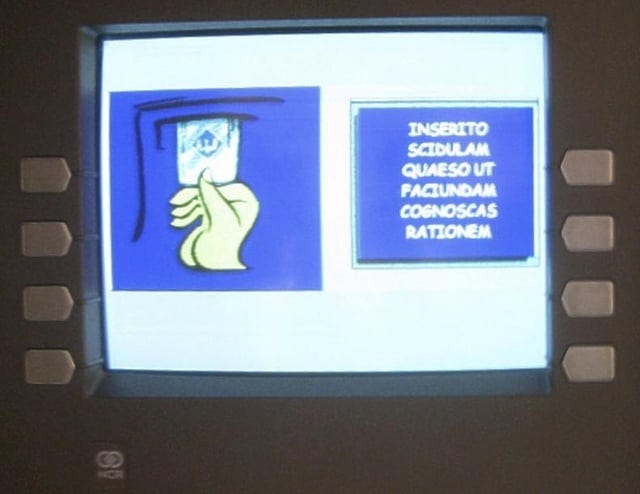
But I couldn’t speak Latin myself, and while I’ve improved a bit around the edges, I could not quite find the time to develop real proficiency while also having babies, figuring out how to homeschool other essential subjects, and making cheese.
So I looked for some shortcuts. And here is the method I developed, which, to toot my own horn for a minute, led my first student to a 5 on the Latin AP exam in only 10th grade, six consecutive golds on the National Latin Exam, and, most meaningful to me, hearing and understanding an unfamiliar and complex Latin passage read aloud.
The heart of the method is simple: Every week, the student is assigned a lectio in Hans Ørberg’s Familia Romana. Every day that week, he reads the lectio while listening to a recording.
We use Luke Ranieri’s excellent recordings that used to be on his YouTube channel, but they have been taken down (I’d love to know how many copies of Familia Romana Hackett has sold in the last ten years thanks to Ranieri’s work, but whatever). Hackett does offer audio in both classical and ecclesiastical pronunciations. Unfortunately they are not nearly as expressive as Ranieri’s readings were, which is a major disadvantage when the goal is not just for the student to learn decent pronunciation, but to actually comprehend what they are hearing. There are also audio recordings available through Legentibus, which I have not heard, but based on other material of theirs I have heard, I would assume are better than Hackett’s.
Sometime in the middle of the week, I have a conversation with the student to make sure they understand what they are reading and hearing. We do not discuss grammar, declensions, cases, etc. At the end of the week, the student reads aloud the passage to me, so I can evaluate how well I think they have understood by their expression.
The student has daily copywork or dictation exercises in the first few years, transitioning to composition exercises as he progresses (I like The Gateway for this, but you could use North and Hillard, which has a key available online).
The student also has to read independently for 15-20 minutes a day in some Latin book substantially easier than his current reading in Familia Romana. I’ve assembled a decent collection of vintage Latin readers, such as Cornelia, Julia, Ora Maritima, Carolus et Maria, as well as a few of the more recent publications by living Latin pedagogues, and the student can pick whatever he wants from that shelf.
We do study explicit grammar, but I have it lag behind the reading by quite a bit, so that the student has had many, many, many exposures to a form before learning the labels and paradigms. We just use Allen and Greenough for grammar study, but you could also use any grammar-centric published program.
The weak part of this program is active practice producing Latin. Copywork, dictation, and composition are slowly effective over time, and I also do make some use of the pensa and exercitia in Familia Romana. But my experience has been that, just as published programs do not include nearly enough Latin text for students to gain real facility with reading, neither do they include enough repetitions for producing the forms in context. I spent a lot of time thinking about this last year and am now attempting to vibecode a Latin practice app inspired by Teach the Latin, I Pray You, the excellent manual by Jesuit Paul Distler.
Many homeschoolers do study Latin explicitly for the grammar drill, so I know this method isn’t for everyone, but even so, I think it would be easy to supplement a more conventional grammar-translation program with a short daily reading and listening routine and see improvements in your students’ comprehension of written Latin.
John Byron Kuhner discuss this in his interesting talk on a via media between active/spoken and grammar-translation Latin teach methods.
I competed in Certamen for many years and teach Lingua Latina now so I am excited to follow up the the additional resources you mention here!
Thank you for this summary! Very encouraging and applicable to multiple languages! My budding linguist is heading into seventh grade and I need a good vision for meeting our language goals.